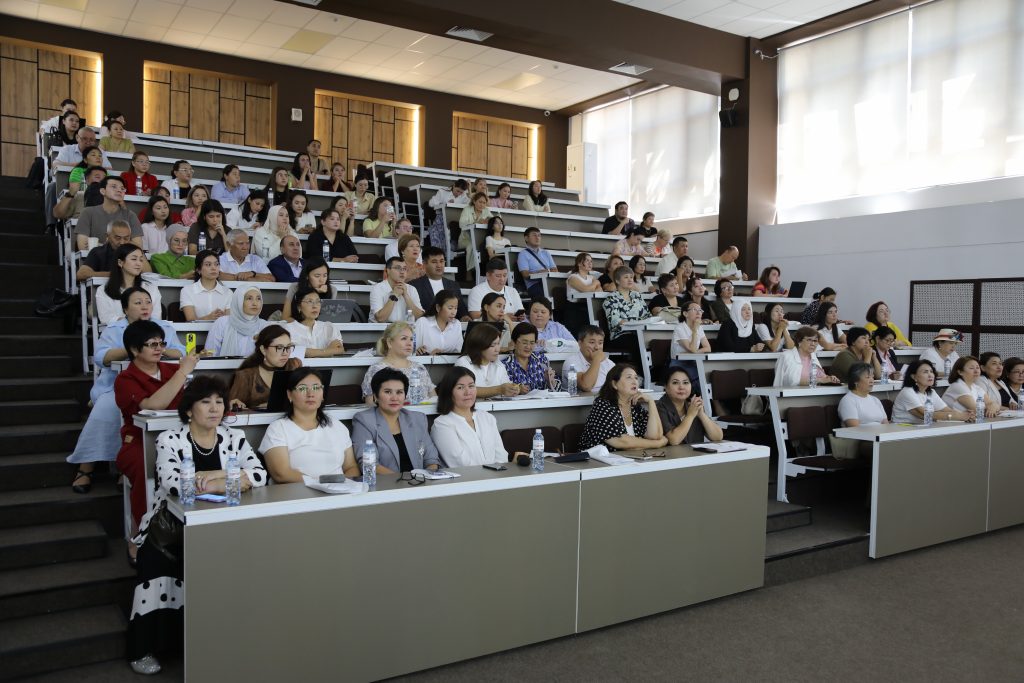
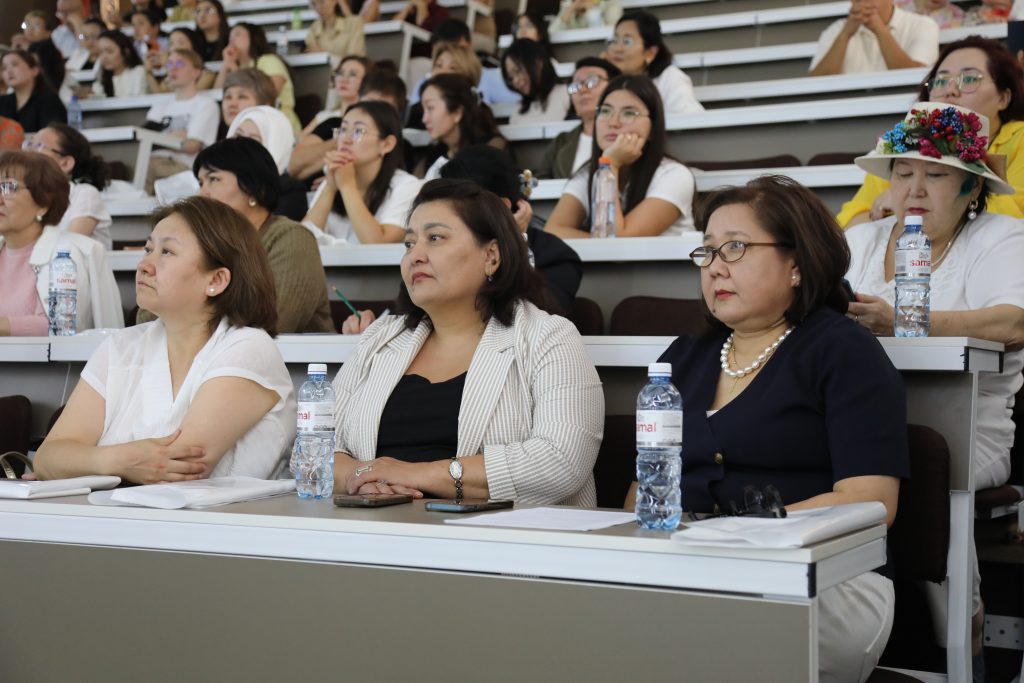
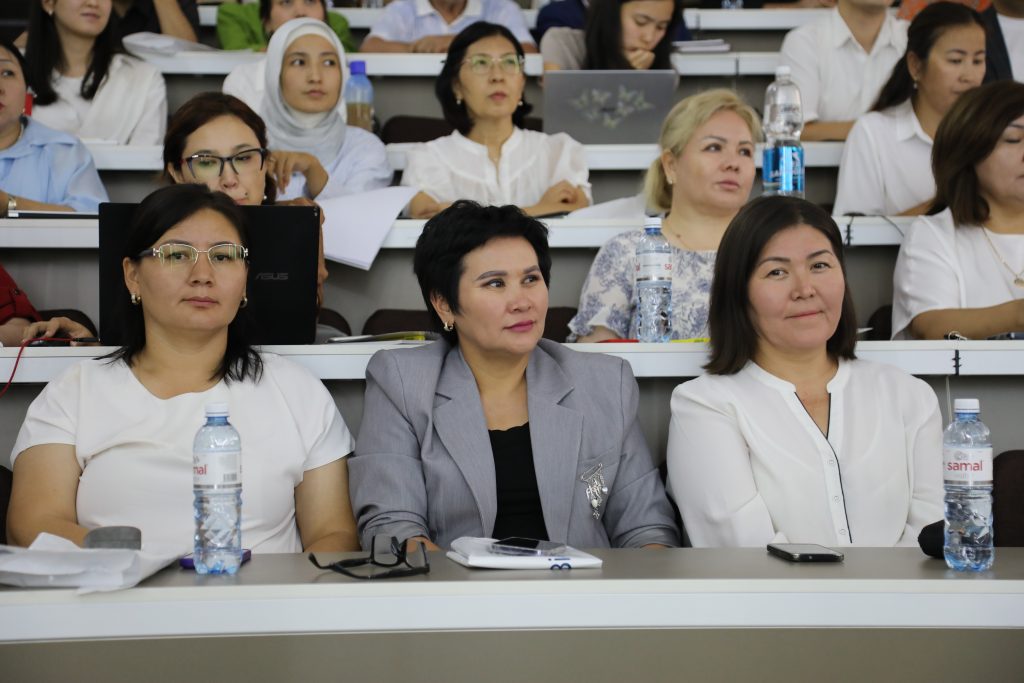
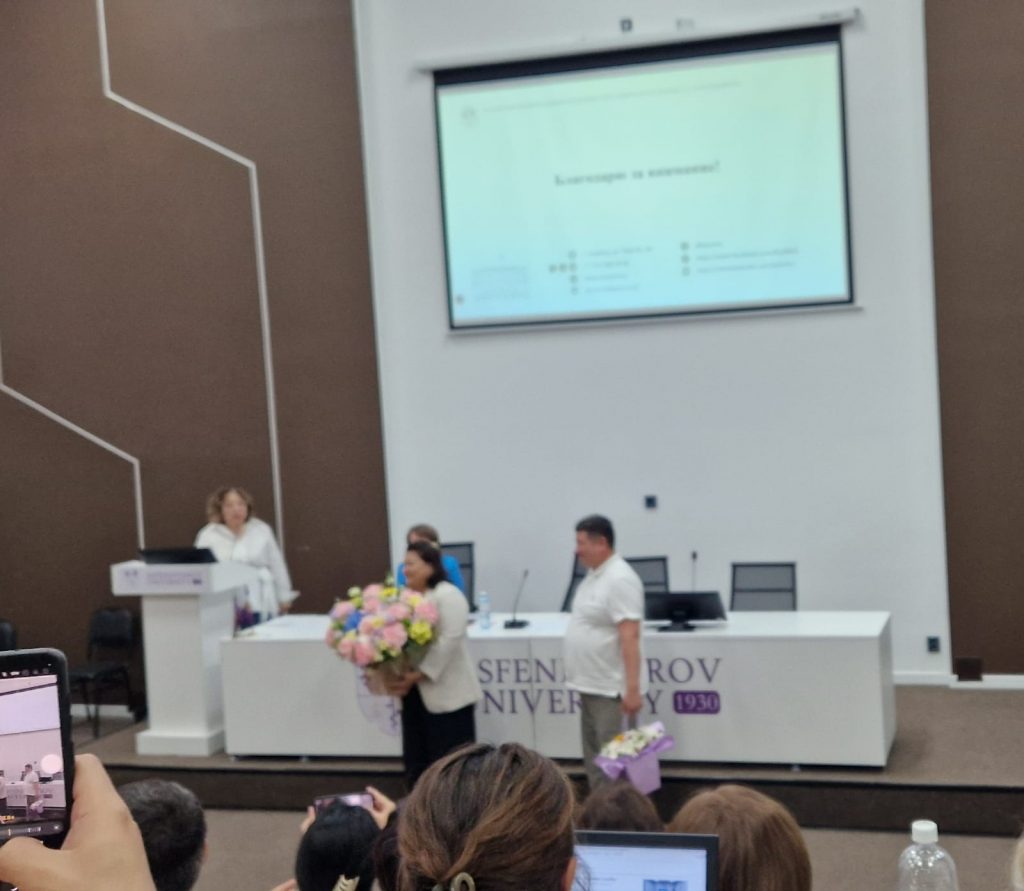
At the end of August, the traditional August Conference of the Faculty and Teaching Staff kicked off at the S.D. Asfendiyarov Kazakh National Medical University. This year’s conference is themed “The Future of Medical Education: Quality, Innovation, Digital Transformation, and Faculty Development.” The focus is on the results of the past academic year, goals for the new academic period, the transformation of medical education, the development of science and clinical training, the digitization of university processes, and the enhancement of faculty members’ professional capabilities.
The first, strategic part of the conference was opened by the Chairman of the Board—Rector of KazNMU Marat Yedigeevich Shoranov—and members of the University’s Board, who presented key performance results and outlined priority areas for KazNMU’s development for the 2026–2027 academic year.
The focus was on the further transformation of KazNMU into a unified educational, scientific, clinical, and developmental ecosystem; the implementation of new models of medical education and digital solutions; the development of scientific and technological potential; and the improvement of collaboration with clinical partner institutions.
The second day of the August 2026 Conference was devoted to the practical exchange of experiences, modern approaches to teaching, digital transformation, and the development of professional and managerial competencies.
“Teaching Quality and Effectiveness: Updating Educational Content, Modern Teaching Methods, and Best Practices in Educational Programs” was attended by the faculty of the School of Pharmacy, staff from the School’s Dean’s Office, master’s students, and doctoral candidates.
The goal of the session was to improve the quality of teaching by updating educational content, applying modern teaching methods, and sharing effective pedagogical practices.
The Dean of the School of Pharmacy, Z.B. Sakipova, Ph.D. in Pharmaceutical Sciences, delivered a welcoming address to the meeting participants. In her report, she summarized the academic year for the “Pharmacy” and “Pharmaceutical Production Technology” programs and presented the results of the School of Pharmacy’s admissions campaign for these programs at the bachelor’s, master’s, and doctoral levels.
The presentations by meeting participants focused on current issues in research and educational activities:
– “Digitization of Teaching Load Calculations for Faculty Members: New Opportunities and Approaches,” presented by A. E. Tumambaeva, Head of the Department of Educational Planning and Quality Control;
– “Scientific Potential and International Opportunities for the School of Pharmacy’s Faculty: Projects, Achievements, and the ‘Bolashak’ Program,” presented by A. K. Boshkaeva, Chair of the School of Pharmacy’s Scientific Council;
– “Updating Course Content to Reflect Contemporary Requirements for Pharmaceutical Education, Learning Outcomes, and the Needs of Practical Healthcare,” by M. I. Tleubayeva, Associate Professor;
– “Monitoring the Quality of the Educational Process as a Tool for Its Continuous Improvement,” Chair of the Academic Council of the School of Pharmacy, Sh. E. Aitkulova;
– “Effective Teaching Methods and Instructional Materials of the School of Pharmacy’s Faculty: Successful Experiences and Opportunities for Using AI,” Associate Professor S.O. Orynbekova, doctoral students A. Keleke and E. Izteleuova;
– “Young Scientists at the School of Pharmacy: Potential and Prospects.” A master class on sharing experiences gained through the “Bolashak” program, presented by Associate Professor U.S. Alimova, Chair of the Young Scientists’ Association.
The School of Pharmacy’s programs at KazNMU are constantly updated to keep pace with the latest global trends and innovations in the pharmaceutical industry. Students are trained through modern educational programs that combine theoretical and scientific knowledge with the practical skills necessary for effective future work.
At the initiative of the Dean of the School of Pharmacy, Professor Z.B. Sakipova, the B085 educational program—“Pharmacy”—with a shortened duration of study on a fee-paying basis is being actively implemented at S.D. Asfendiyarov Kazakh National Medical University. This program is offered to applicants who have completed a pharmaceutical education at a college (TIPO) or hold another higher education degree. The duration of study ranges from 2 to 3 years, depending on the applicant’s prior level of education and its focus. For example, graduates of the OP TFP program study for 2 years, while those who have completed TIPO (the pharmaceutical department of a medical college) study for 3 years.
An individualized study plan is developed for each student admitted to a program with a shortened duration of study; this plan depends on the student’s prior level of education and the courses completed at that level. A committee comprising experienced faculty members and its chair conducts an interview on specialized subjects. Applicants who achieve the minimum passing score are admitted to the “Pharmacy” educational program with an accelerated study duration.
This study option is becoming popular because it allows students to combine university studies with work in their field.
For those who have completed a bachelor’s degree in “Pharmaceutical Production Technology,” the option of pursuing a shortened two-year bachelor’s program in “Pharmacy” is particularly attractive. In this case, the graduate receives two bachelor’s degrees: one in “Pharmacy” and one in “Pharmaceutical Production Technology.” Such graduates are in high demand and highly versatile: they can work in healthcare, engineering, and manufacturing.
This year, 519 students graduated with a bachelor’s degree in the “Pharmaceutical Production Technology” program, and 88 students graduated with a bachelor’s degree in the “Pharmacy” program.
Graduates of the School of Pharmacy work in the healthcare system, as well as in the pharmaceutical, chemical, food, and related industries—from the development and production of medications to ensuring their availability to the republic’s population. Many of them work in government agencies at the national and regional levels. Among them are numerous candidates of pharmaceutical sciences, doctors of pharmaceutical sciences, directors of pharmaceutical companies, pharmacy managers, and faculty members at medical universities and colleges. Graduates of the School of Pharmacy work in all regions of Kazakhstan, as well as in CIS countries, Europe, Asia, the United States, and Canada.
This year, 198 students were admitted to the “Pharmaceutical Production Technology” program, of whom 94 will study on a grant and 104 under a contract. Fifty students were admitted to the “Pharmacy” program, of whom 10 will study on a grant and 40 under a contract. The duration of study for the “Pharmaceutical Production Technology” program is 4 years, and for the “Pharmacy” program, 5 years.
For the “Pharmacy” program, 78 students were admitted to the 2-year accelerated track (for graduates of the “TFP” program) and 50 students to the 3-year track (for graduates of other universities), for a total of 128 students in the accelerated program.
Students at the School of Pharmacy regularly win international competitions, participate in research projects, and complete internships abroad. Collaboration with leading international pharmacy schools, pharmaceutical manufacturers, and pharmaceutical companies, as well as the development of practice-oriented programs, remains a key focus of the school’s work.
Every year, more than 15 faculty members from the School of Pharmacy participate in international internships in CIS countries, Europe, Asia, and the United States as part of the “Bolashak” program and other international programs and projects.
A fourth-year student majoring in “Pharmacy,” Kamila Armanovna Alimzhanova, has been awarded the S.D. Asfendiyarov Named Scholarship.
The faculty of the School of Pharmacy consists of highly qualified specialists from the S.D. Asfendiyarov Kazakh National Medical University who hold academic degrees and titles. Renowned foreign instructors and experts from CIS countries, Europe, the United States, and Asia are also invited to deliver lectures and conduct seminars and practical sessions.
Bachelor’s degree graduates may continue their studies in a master’s program: a two-year research-and-teaching track or a one-year specialized master’s program. Upon completion of the master’s program, those wishing to pursue research or teaching careers have the opportunity to enroll in a doctoral program.
Educational programs at all levels in the specializations of “TFP” and “Pharmacy” are continuously improved to ensure that the curriculum meets current requirements and the needs of employers. Each year, the university analyzes labor market needs, updates the competencies of graduates, and develops joint solutions to improve the quality of training for professionals capable of working effectively in the modern pharmaceutical industry.
egular meetings with employers provide an opportunity to discuss trends in higher education in the field of pharmacy: global approaches to teaching, the use and integration of technology, fostering creativity, the spread of mobile technologies, active project-based work, and education without borders and mobility.
The pharmaceutical industry in the Republic of Kazakhstan is actively developing, and it undoubtedly needs qualified specialists who will take the industry to a new level of innovation. The S.D. Asfendiyarov Kazakh National Medical University is training a generation of precisely such specialists, who possess the knowledge to develop and manufacture competitive pharmaceuticals.
The 2024–2028 development program of the S.D. Asfendiyarov Kazakh National Medical University sets new tasks for the university and the School of Pharmacy to achieve its strategic development goals. Plans include further improvements to technological infrastructure and the refinement of educational programs. The School of Pharmacy operates a practical skills center and a simulation center, both equipped with state-of-the-art equipment. A Center for Pharmacy and Pharmacology has been established to conduct innovative research.